
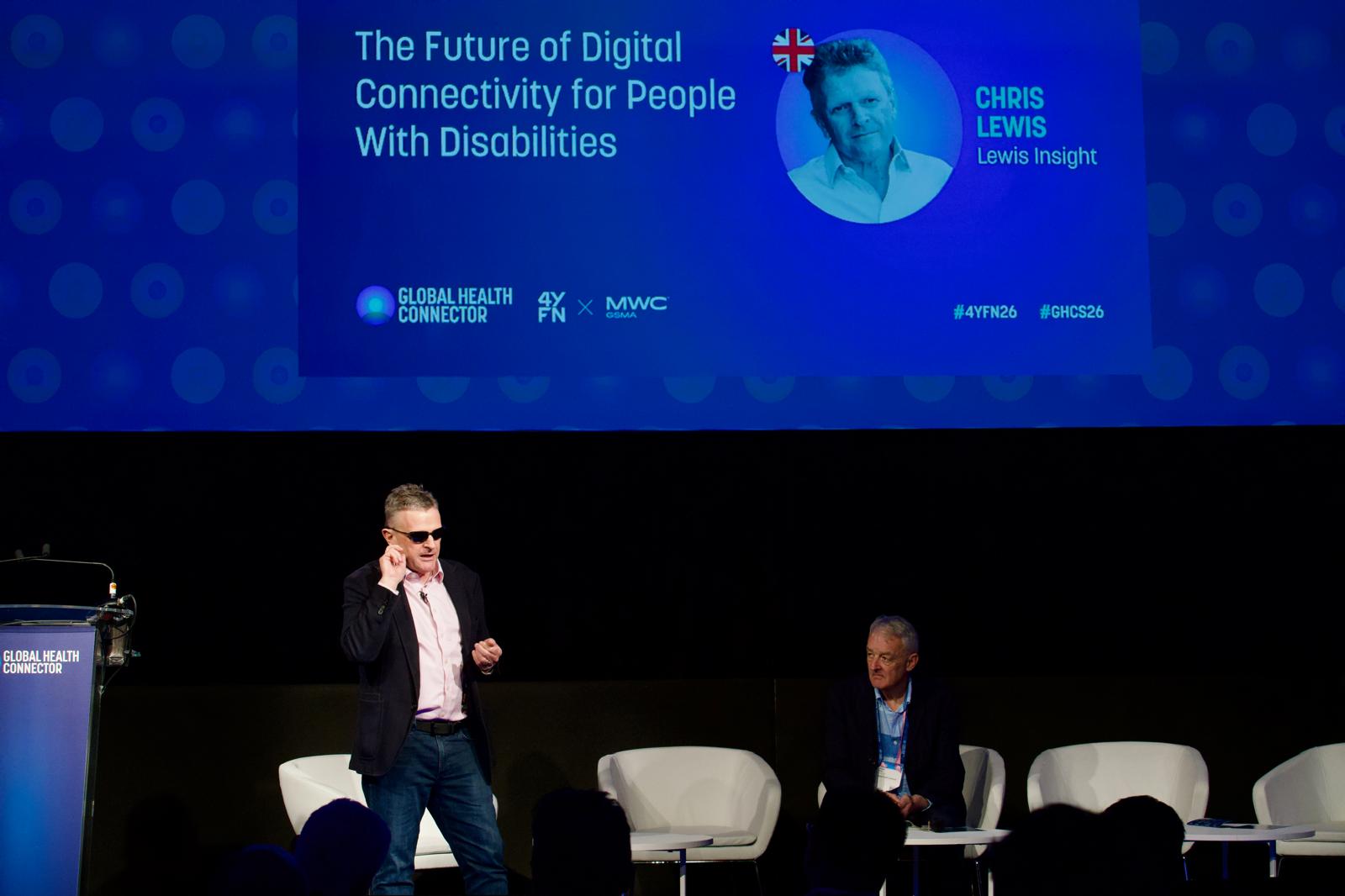
At the Global Health Connector Summit in Barcelona in March, part of the GSMA’s 4YFN programme, I returned to the stage to share my perspective on People With Disability (PWD) in the context of the healthcare system. I had presented at this event 8 years previously when I offered the audience the 1970’s 6 Million Dollar Man rebuilt in current pricing for around $150,000. Those components have continued to reduce in price and sophistication but I suspect the human costs of doing the surgery will have surged!
Taking a healthcare lens on PWD makes absolute sense to me. After all, we are born into the healthcare system, interact with it variously during our lives and the have a final interaction at the end. Plus, specific medical conditions such as sight loss in my case, have speciality hospitals focused on the condition. Accademia also has its focus on different aspects and is benefiting from the AI premium when it comes to analysing vast quantities of data in the form of scans, imaging and the massed ranks of patient records.
However, I recently discussed the patient journey with one healthcare professional, attempting to build a new, AI and connectivity fuelled pathway for the patient. The opening comment was around how an individual would enter the hospital, register on a touch screen and be given guidance to the appointment location including timings and location. Stop, I said, how am I, as a blind person, supposed to use that touch screen, or my 93 year old mum, people lacking the digital skills or cognitive issues preventing them from navigating the touch screen. That started a whole discussion about how the patient journey must be designed inclusively from the start. Options for the patient to interact with the hospital systems, information about appointment location and timing have to be delivered in a format suitable for the patient and not dictated based on the technology preferences of the healthcare professionals and the hospital.
We are at a point in communications evolution where we have gone full circle from grunting and gesturing to each other, gone through the creation of symbols and alphabets, codified them into languages, digitised them into code and can now translate between all forms of communications through AI-powered tools. So, we have no excuse for not providing individuals with their preferred channel of communication. Indeed, the power of the emerging voice interface means that we can even talk to the system in one language and receive an answer in another and have that translated into another if realtime required.
At the same time the development of wearables, sensor patches and monitoring devices are able to be wrapped around the individual providing the individual, carers and medical workers a rich stream of information about the individual. This also manifests itself in the convergence of medical grade and consumer electronics. Hearing aids are joined by earbuds that can provide some degree of hearing assistance, smart glasses, accompanied by AI, can help provide input for the individual and other wearables can feed information back to us all.
In the hospital environment the introduction of smart building technology and robots also present a more interactive and personalised future. Many years ago I presented to healthcare professionals about the customisation of lighting based around the Philips Hue bulbs. Everyone was attracted to the customisation of lighting for each patient depending on their personal preferences. I benefit, for example from very low levels of lighting with little from overhead. Some other Vision Impaired people prefer very bright light from directly overhead!
The economics of hospitals and a shift to individual rooms (to reduce the risk of infection) for patients also presents some issues. Robots can help with patient care, maintaining a safe environment, even helping patients get in and out of bed let alone some personal interactions given the power of their communications tools today. The human factor is, of course still critical: nursing numbers cannot be grown significantly but monitoring of patients via robots and sensors in the individual rooms will make the nursing staff way more efficient. The danger is that the care becomes very impersonal and hence not aiding swift recovery when human interaction is a vital component’s
This approach extends naturally into the realms of the GP and our daily interactions with our local surgery and doctors. Perhaps even more powerful is the extension into the home and social care and supporting independent living. Those hospital robots will serve us well in the home supporting independent living and even providing some social contact and interaction for people.
All of this requires significant connectivity power and coverage down into the home. Furthermore, the availability of low cost sensors, patches that communicate medical information back to the individual, to carers, medical staff, even insurance companies means we will have multiple information flows inside and outside of the home.
The question I posed at the end of the Health Summit was whether we are designing systems and processes that we expect the humans to adapt to or whether we should design them to adapt and allow the individual to choose their modes of interaction. After all, we have spent decades adapting to the rigid structures of IT and medical devices. The current wave of devices, sensors and AI tools must be embraced to reduce the friction that all too often causes the patient frustration and causes blockages in the delivery of healthcare and social care.
The theory of Inclusive Design has been around for over thirty years. We now have the tools to make it happen. Let’s not be victims of technology and systems constraints but truly put the human at the heart of our design whether we are designing medical devices, patient systems or whatever. I summarised the situation through a series of concentric circles with the individual at the centre, the household around that, hospital environments around that and society as a whole on the outside. We must ensure that connectivity allows for free information flows to and from each layer of the picture to ensure that outcomes benefits from the power that modern communications, smart devices and refined healthcare processes bring to the table.