
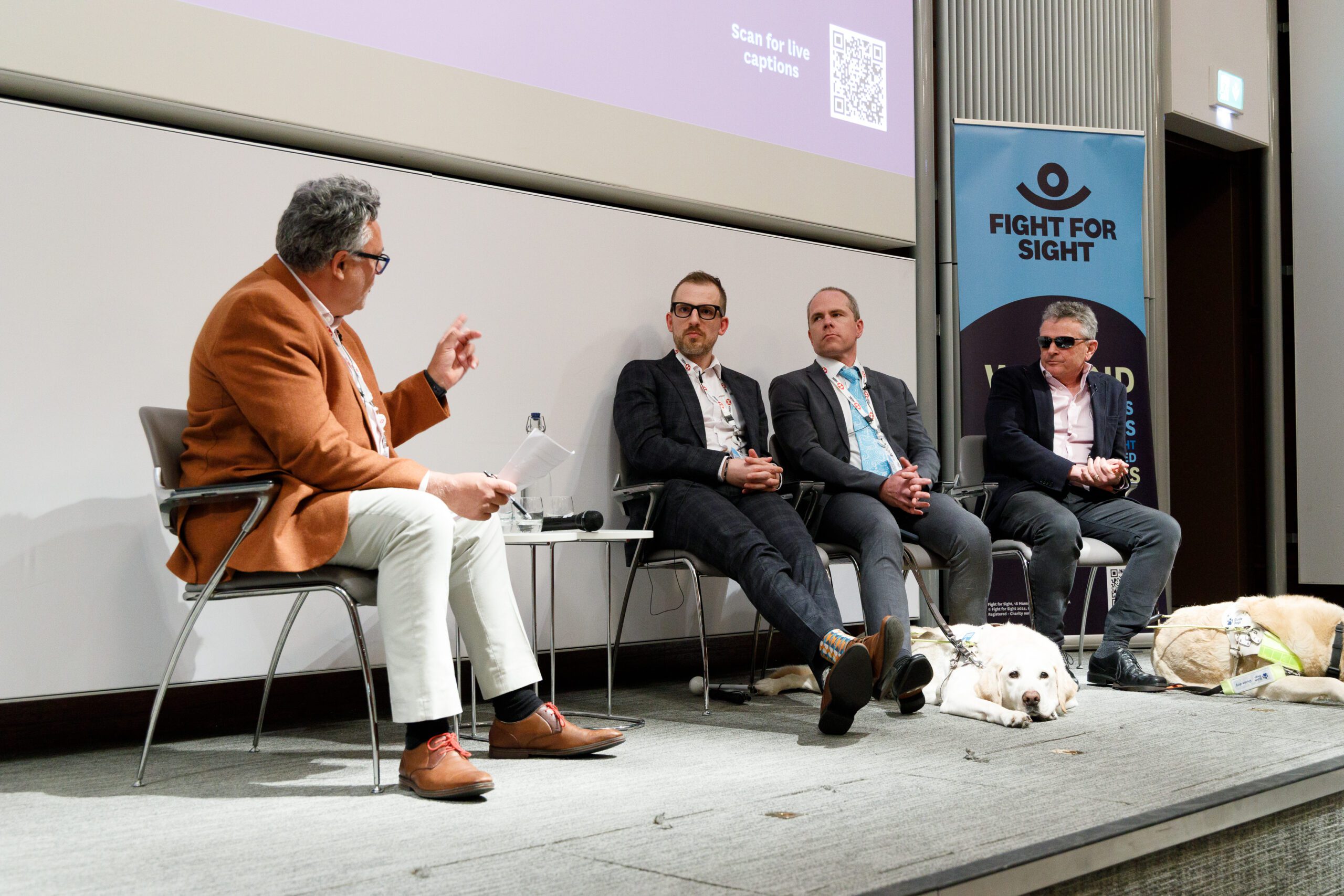
How a panel of blind technologists, an accessibility chief from Unilever and a room full of screens (and phones) made the case for agentic AI as the next big step for inclusive design.
As with every part of our personal and business lives, AI is set to play a pivotal role in changing the lives of people with sight loss. As a blind user of digital services through smart speakers, smartphone and laptop, I was delighted to join the AI panel at Fight for Sight’s Vis-Ability conference in London recently, alongside Mark Powell, Head of Accessibility at Unilever, and Andy Lane, Product Manager at Be My Eyes, with the session chaired by Andy Bailey, also of Be My Eyes.
Before the panel, the Minister for Work and Pensions, the Right Honourable Pat McFadden, set the tone by talking about “changing the exam question” to reflect today’s environment. Where AI is concerned, that framing is spot on. The obsession with building ever more powerful LLMs needs to give way to the practical application of AI tools as part of the digital lifestyle we actually need. That’s true for everyone, but on this occasion we were looking at it through the lens of people with sight loss.
A sighted person in your pocket
All three of us panellists are registered blind; two of us have guide dogs, and all of us are living our lives assisted by technology and AI as it evolves. We agreed that AI tools are giving us far greater exposure to the world around us: describing what’s in front of us, translating information into content we can actually use, and doing the heavy lifting when it comes to finding information, creating content and engaging with service providers of all kinds.
Andy Lane, a fellow guide dog user, put it neatly when he described his phone as “a sighted person in my pocket.” He also shared the slightly disconcerting experience of using AI to get a sense of how an audience looks from the stage — discovering that plenty of people weren’t looking at the stage at all, but at their phones and laptops. I’ve made a similar comparison myself before: the camera on my phone acts as a proxy for my eyes, the microphone for my ears, and the apps and processing power behind them as a stand-in for parts of my brain. AI simply moves that relationship on to another level.
From centralised models to agents on the edge
The shift from large language models to smaller models, and especially to AI capabilities running locally on our smartphones, speakers and laptops, is bringing us into the era of agentic AI. We talked about the risk of bias remaining baked into models unless it’s actively addressed at the point of creation or update — and removing bias from massive, centralised models is still proving difficult.
The more encouraging news is that as power shifts out to the edge and onto our own devices, we get the chance to use agents that understand our personal preferences, shaped by our own particular experience of sight loss. That offers a real counterbalance to bias in the big LLMs: rather than trying to fix everything inside the mega data centres, we can start to address it from the outside in, through the millions of individual interactions each of us has with our own agents.
This is another example of how the digital world can genuinely embrace accessibility and Inclusive Design in a way that benefits everyone, not just one group of disabled people served by one piece of technology. The real challenge is the negotiation between agents and the orchestration of the swarms of agents now emerging at every level. But the goal has to be usability, not simply compliance with accessibility or Inclusive Design standards.
AI is not the answer — it’s part of the solution
One thing that struck me during the discussion is that AI isn’t the answer in itself. It’s a set of tools to be used in different situations, and the human element of providing intelligence is still just as important. You can see that clearly in the Be My Eyes portfolio, where more than 10 million human volunteers work alongside the AI version of the service to meet different needs. For all its power, AI still isn’t as quick as a human at telling me which spice pot on my rack is chilli flakes, or helping me work out how to set the thermostat in a hotel room. AI is not the answer; it’s part of the solution, and it will be deployed in many different ways across many different situations.
Designing for the whole journey
Mark Powell’s role as Head of Accessibility, globally, for Unilever brought a valuable business perspective. As a consumer goods company, Unilever is acutely aware of the need to design its products so that AI can help identify packaging and usage instructions, supporting the end-to-end customer journey from the retail shelf all the way to pulling clean clothes out of the washing machine at home.
My own perspective, as a blind person working in the tech sector, is of an ever-closer relationship between the power of tech solutions and the breaking down of barriers, not just for people who are vision impaired but across the boundaries between different disabilities: hearing impairment, age-related decline of the senses, and the ability to consume and create content in whatever way suits the individual.
Education is still the critical piece
Education kept coming up throughout the discussion, whether for vision impaired people, the “silver market” of older users, or the product and service developers designing for them. My own younger brother, who is also blind, struggles with his iPhone and is frankly scared of AI and what it might do for him. That’s a common story. We need to build both AI literacy and critical thinking into the education system from an early age, and make sure that everyone experiencing a life-changing disability, such as losing their sight, gets practical training in how to get the best out of the technology available to them.
AI is already helping improve the way we interact with our devices, opening up the ability to move between voice, chat and AI-driven channels. But that requires the business world to do more educating of its own, to make sure people can choose the interaction channel that works for them, rather than being funnelled down a bot route that simply isn’t accessible.
From compliance to genuine empowerment
The view from the individual side, whatever the impairment, is increasingly positive. The challenge for business and society now is to move beyond merely complying with accessibility standards, towards a genuinely empowering, fully accessible set of services — ones that let everyone benefit from the digital dividend and bring many previously excluded groups into the working population.
Involving people with lived experience of different disabilities is key to shaping these new inclusive experiences. Those voices need to be heard. But if the design process allows for all the permutations of personal choice from the outset, then the systems behind the services will naturally create an accessible environment as a by-product of good design, rather than as an afterthought. That’s a narrative we need to establish now, so it has time to take hold.
My call to arms is for developers of all agents, personal, business and public sector alike, to embrace the requirements of every potential user of a service and allow improvements to flow freely in every direction. The good news is that deep technical knowledge of how AI or agents work, on either the supply or demand side, isn’t essential for the rest of us. The services we use to access the digital world are increasingly learning to speak our language, rather than expecting us to speak theirs. Natural language is becoming the lever we all get to use, whether it comes out of our mouths or through our fingertips.
Thanks to Mark Powell, Andy Lane, Andy Bailey and the Fight for Sight team for a genuinely thought-provoking session.
#Accessibility #InclusiveDesign #CustomerExperience #PersonalAgents #AgenticAI #FightForSight